The Humane Hierarchy in dog training
The Humane Hierarchy has had an important influence on modern animal training. Developed by Dr. Susan Friedman, professor emeritus in the Department of Psychology at Utah State University, it offers a structured way to think about the procedures we use when trying to change behaviour. Friedman’s work applies principles of learning and behaviour across animal-care and training settings.
At its core is an ethical question: if more than one approach could work, which option is likely to be effective while giving the learner the greatest degree of control and using the least intrusive procedure? Friedman describes this as the least intrusive principle and argues for using a procedural hierarchy to guide those decisions.
The Humane Hierarchy is one useful framework for procedure selection. Other models in animal welfare and behaviour ask different questions about the learner’s overall welfare, agency, behavioural function and available choices.
Quick takeaways
- The Humane Hierarchy helps guide ethical choices in behaviour change.
- Health, environment and antecedent arrangements are considered before moving towards more intrusive procedures.
- Positive reinforcement has an important place within the hierarchy.
- The framework is designed to support thoughtful procedure selection rather than simply asking whether something changes behaviour.
- Other frameworks, including the Five Domains, LIFE and constructional approaches, can add different perspectives on welfare, function, agency and choice.
What is the Humane Hierarchy?
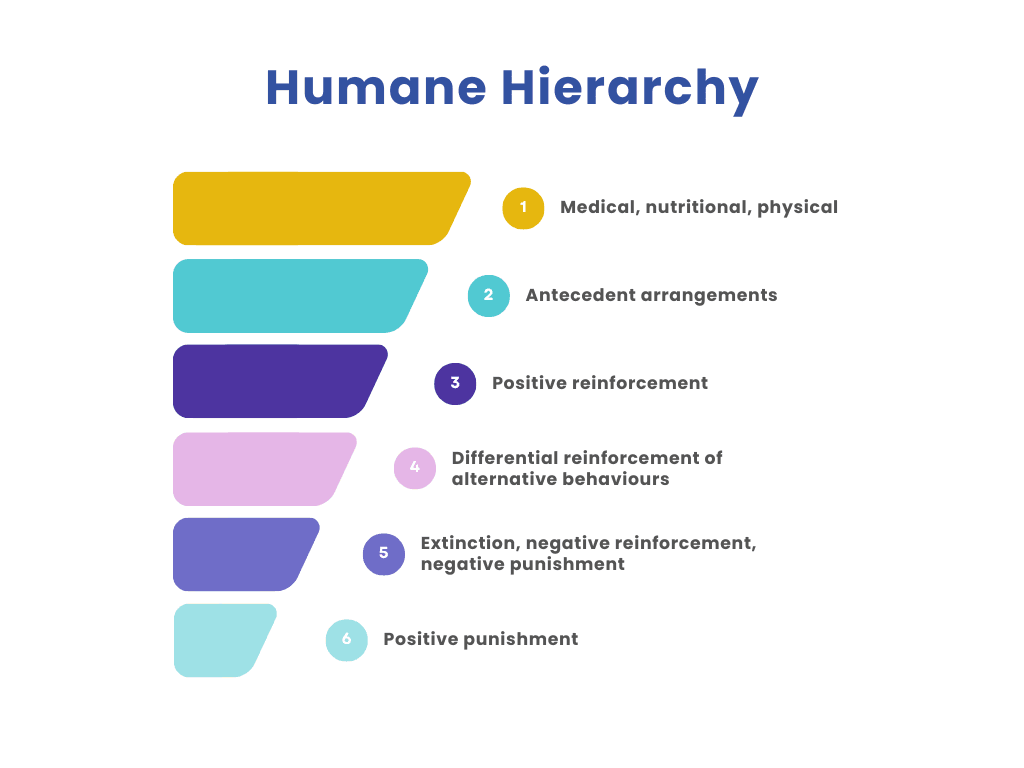
The Humane Hierarchy organizes behaviour-change procedures according to their intrusiveness and the degree of control available to the learner. Friedman’s procedural hierarchy begins with health, nutrition and physical wellbeing, followed by changes to antecedents and the environment, before moving through different behaviour-change procedures.
For dog guardians, one of the most useful ideas is that the behaviour we see may be only one part of the picture. A dog who suddenly resists handling, reacts on walks or struggles to settle may also be dealing with pain, stress, environmental pressure, previous learning or a situation that has simply become too difficult.
That can change where we start. Sometimes a veterinary assessment, more distance, a change in routine or a different setup needs attention before formal training does.
Why the framework is useful
The Humane Hierarchy encourages trainers to consider both effectiveness and the experience of the learner. Friedman has argued that effectiveness alone isn’t enough when choosing behaviour-change procedures, and that less intrusive effective options should be considered first.
One practical example is antecedent arrangement, which means changing what happens before a behaviour so the learner has a better chance of succeeding.
A dog who reacts when another dog is three metres away may be able to learn comfortably at twenty metres. A dog who struggles when visitors arrive may cope better behind a gate with space and something enjoyable to do. A dog who suddenly resists being touched may need a veterinary check before anyone starts a training plan.
Management and environmental changes can reduce stress, prevent repeated difficult experiences and create better conditions for learning.
How the Humane Hierarchy guides procedure selection
The hierarchy gives priority to approaches that support successful behaviour without unnecessarily increasing intrusiveness.
Positive reinforcement is one of those approaches. In everyday dog training, that might mean reinforcing a loose leash, a voluntary check-in, settling on a mat, moving away from something difficult or choosing an appropriate object to chew.
The framework also encourages careful reflection when a plan isn’t working. Friedman’s writing on the least intrusive principle emphasizes thoughtful procedure selection rather than relying on effectiveness as the only criterion.
That leaves room to ask whether the criteria are too difficult, whether the environment is working against the learner, whether health or stress is affecting behaviour, or whether the chosen reinforcer actually matters to the animal.
Other frameworks that broaden the picture
The Humane Hierarchy focuses primarily on behaviour-change procedure selection. Other frameworks used in animal welfare and training focus on different parts of the picture.
The Five Domains
The Five Domains Model is a framework for structured animal-welfare assessment. Its current form considers:
- nutrition
- physical environment
- health
- behavioural interactions
- mental state
The first four domains help identify factors that may contribute to positive or negative subjective experiences, which are considered in Domain 5, Mental State. Domain 4, Behavioural Interactions, specifically includes interactions with the environment, other animals and humans, with particular attention to agency and goal-directed behaviour.
For companion dogs, that gives us a way to look beyond the immediate training problem and consider physical comfort, environmental conditions, relationships, behavioural opportunities and the dog’s broader lived experience.
At Belle & Bark, the Five Domains provides the broader welfare framework I use most often.
LIFE
The Least Inhibitive, Functionally Effective (LIFE) model was proposed by Dr. Eduardo Fernandez as a framework for ethical animal training. It emphasizes a direct connection between training practice, behavioural science and welfare science, with particular attention to behavioural function and inhibition.
The focus on function is especially useful when trying to understand why a behaviour persists. Barking may help create distance, pulling may provide access to something interesting, or another behaviour may reliably produce attention or escape from a difficult situation.
Understanding what the behaviour achieves can help guide the alternatives we build.
Constructional approaches
The constructional approach comes from behavioural science and focuses on building useful behavioural repertoires rather than centring the plan on eliminating unwanted behaviour.
Recent animal-training literature describes constructional work as emphasizing new behavioural options, contingency analysis, genuine choice and access to meaningful outcomes.
A useful question from this perspective is: what would we like the dog to be able to do, and what skills would help make the difficult behaviour less necessary?
How these frameworks fit together
These frameworks were developed for somewhat different purposes.
The Humane Hierarchy helps organize decisions about behaviour-change procedures. The Five Domains provides a structured way to assess welfare and the animal’s subjective experience. LIFE emphasizes behavioural function and the degree to which training inhibits the learner, while constructional approaches focus on building useful behavioural repertoires and effective alternatives.
Current professional standards reflect several of these themes. The IAABC’s Joint Standards of Practice ask practitioners to consider physical and emotional wellbeing, environment, safety, health, learning history and opportunities for choice and control. They also identify positive reinforcement as the primary training strategy and oppose the intentional use of pain, fear or intimidation.
Looking across these frameworks can help broaden the questions we ask around a behaviour: what may be contributing to it, what the animal is trying to achieve, what their welfare picture looks like, and what skills or environmental changes would help.
How this looks at Belle & Bark
When I’m looking at a behaviour concern, I start by gathering information about the dog’s health, emotional state, environment, routines, relationships, learning history and opportunities for rest, exploration and choice.
The Five Domains helps organize that welfare picture. Principles from the Humane Hierarchy remain useful when thinking about management, antecedent changes and procedure selection, while function and agency also shape the kinds of alternatives we build.
Training is often part of the plan, but it may sit alongside veterinary support, environmental changes, enrichment, more distance, increased predictability or changes in daily routine.
When I train, I use positive reinforcement and avoid methods designed to cause pain, fear or intimidation. The aim is to give the dog useful skills while keeping their welfare and experience in view.

Tabitha Turton
Tabitha Turton is the founder and trainer at Belle & Bark, offering dog training and behaviour support in Montreal. Her work draws on current behaviour and welfare science, positive reinforcement and Family Dog Mediation, with a focus on understanding the individual dog and the factors shaping their behaviour.
Her writing explores dog behaviour, learning and welfare, translating research and professional education into practical ideas for everyday life with dogs.