Dog training and agency: Why choice matters
Imagine if your dog could raise their paw and say, “Not right now, thanks.” That’s the heart of dog training and agency. Choice may be one of the most underused tools in building calm, confidence, and cooperation.
Training isn’t just about obedience. It’s about building a life together rooted in trust, safety, and communication. When dogs feel like active participants, not passive passengers, their behaviour improves from the inside out.
Quick takeaways
- Agency = the ability to make choices and influence outcomes
- Choice reduces stress, improves focus, and supports emotional regulation
- Dogs without agency may appear stubborn, but may actually be shut down
- Offering daily choice builds confidence and deepens trust
- Agency goes beyond training cues, it includes how your dog lives day to day
What is agency?
In behavioural science, agency means the capacity to act intentionally and influence outcomes. For dogs, that might mean choosing whether to greet a person, opting into a training session, or deciding where to relax at home.
When dogs are given some control over their lives, they become more confident, regulated, and engaged. Without agency, even kind routines can become overwhelming or disempowering.
Learned helplessness: What happens when choice disappears
In the late 1960s, psychologists Martin Seligman and Steven Maier conducted a series of groundbreaking studies on dogs that revealed how a lack of control can lead to behavioural shutdown. Dogs were placed in harnesses and exposed to mild electric shocks that they couldn’t escape. Later, those same dogs were placed in a new environment where escape was easy, they simply had to jump over a small barrier.
But many of the dogs didn’t even try. They had learned that nothing they did could stop the discomfort, so they gave up entirely. This pattern of inaction became known as learned helplessness. A psychological state where an individual stops trying because past experiences have taught them that their efforts are meaningless.
In dogs, learned helplessness doesn’t just show up in labs, it can happen in real life, too. A dog that’s repeatedly punished, ignored, or forced into situations without choices may begin to check out. They might seem calm or obedient, but in reality, they’ve shut down. You may notice:
- Flat or “zoned out” expression
- Lack of curiosity
- Slowness to respond
- Disinterest in play, training, or interaction
This isn’t laziness. It’s a dog who’s learned their voice doesn’t matter.
Modern neuroscience supports this, too. In the 2016 review “Learned Helplessness at Fifty”, researchers found that the brain’s prefrontal cortex plays a critical role in detecting control. When animals perceive they have control, this part of the brain helps suppress stress responses. But when control is absent (or unpredictably taken away) that protective mechanism shuts down.
So it’s not just emotional. It’s physiological.
And the flip side is hopeful: when dogs experience consistent, safe, and predictable choice, they begin to recover. They try again. They explore. They re-engage with their world. Not because we made them, but because they believe their actions matter.
👉 To explore the science behind how dogs process learning, behaviour, and stress, see our post: How dogs learn: The science behind behaviour and training
What agency looks like in daily life
Agency can feel like an abstract concept. But in practice, it’s a collection of small, consistent choices. These everyday moments shape how your dog sees the world: safe or unpredictable, participatory or one-sided. The more opportunities your dog has to influence their environment, the more balanced and confident they become.
Agency isn’t about chaos or spoiling your dog. It’s about giving them small, meaningful choices within a structured environment.
Everyday choices that build confidence
- Letting your dog choose the walking route
- Offering two enrichment toys and letting them pick
- Allowing them to opt into cuddles instead of assuming they want them
- Giving the option to observe instead of greet
- Respecting when your dog chooses to rest in a different room
Setting up the home for autonomy
- Provide dog beds in multiple spaces (sunny, quiet, social, shaded)
- If safe, offer a dog door to the yard so your dog chooses when to be outside
- Don’t require your dog to follow you constantly, independence builds security
Consent and respect in handling
- Try the “pet for 10 seconds, then pause” rule. If your dog leans in, continue. If they turn away, let them be
- Watch for subtle stress signals: tongue flicks, head turns, lip licks
- Use a consent cue (like a nose touch) before brushing, ear checks, or nail trims
Dogs show us what they’re ready for, we just need to listen.
Training with agency
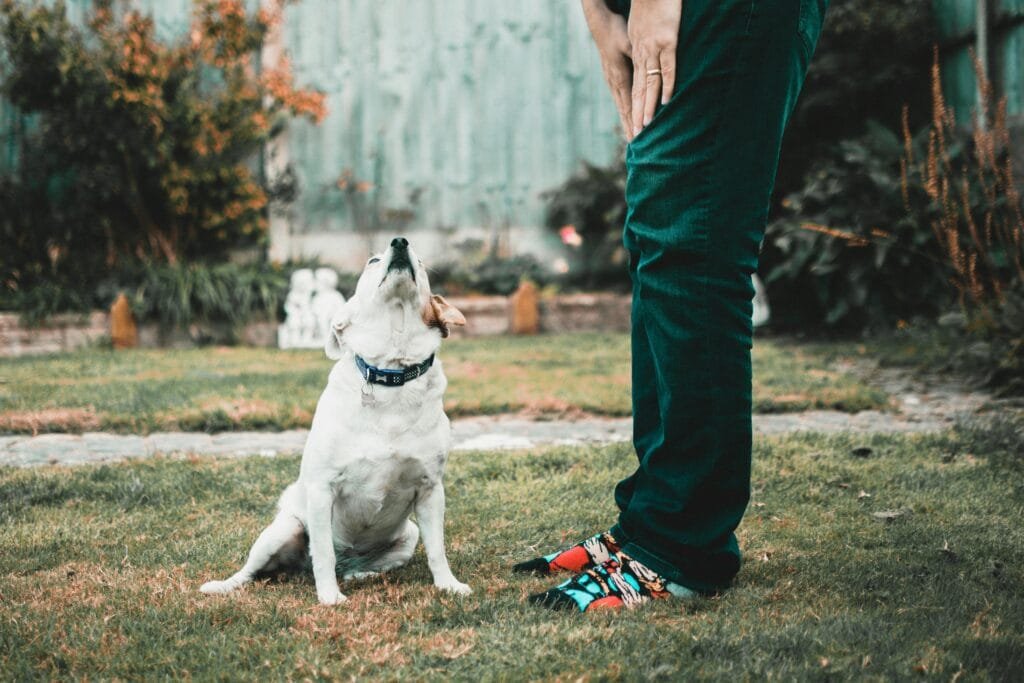
Training can absolutely involve structure and boundaries and give dogs choices. In fact, agency makes training more effective because dogs become willing participants.
Everyday training choices that build agency
Agency in training doesn’t mean letting your dog run the show. It means offering micro-decisions within a structured session. Examples include:
- Keep sessions short (5–10 minutes) and watch for signs of disengagement
- End on a win, not exhaustion or frustration
- If your dog walks away or zones out, pause and assess: Are they tired? Stressed? Bored? Are you motivating effectively?
- Let your dog choose between toys or treat types, or when to take a break
- Offer re-engagement cues like a nose touch, and respect a “no thanks”
These aren’t tricks. They’re ways to let dogs have input, which makes learning faster and deeper.
Cooperative games that build impulse control and agency
Cooperative games are structured activities where your dog has a clear role, choice, and control over the outcome. These aren’t just training exercises or ways to teach cues. They’re structured opportunities for your dog to practice decision-making, self-regulation, and communication in a fun, low-pressure way.
They’re especially helpful for building impulse control through voluntary participation. Instead of being corrected for jumping, barking, or grabbing, your dog learns that calm behaviour creates access to the things they want.
These games can help your dog:
- Build frustration tolerance
- Make good choices under mild stress
- Offer behaviours with confidence
- Feel in control, not confused or coerced
And as a bonus? They strengthen your communication as a team.
- Zen Game
Your dog learns that resisting the urge to grab a visible treat actually gets them the reward. You present a treat in your open hand. If your dog moves toward it, you close your hand. When they back off or pause, the hand opens again. It’s a simple but powerful way to teach, “if I wait, I get what I want.” - Start Button Behaviours
The dog uses a specific cue (like placing their chin on a towel or nose targeting your hand) to indicate readiness for the next step: brushing, nail trims, vet handling, etc. If they pull away, the session pauses. This puts the dog in control of starting or stopping the interaction. - Mat Work
The dog is taught to go to a designated mat and settle. Over time, they learn that staying on the mat leads to calm reinforcement (treats, praise, breaks). It promotes impulse control and gives them a clear, cozy space they choose to return to during excitement or stress. - Pattern Games (from Leslie McDevitt’s Control Unleashed)
These are predictable, repetitive movements (like “1-2-3 Treat” or “Up-Down”) that help dogs anticipate what happens next. When dogs know what to expect, they can better choose to engage or disengage from stimulation in a safe, supported way. - Shaping Games
These reward successive approximations of a behaviour, allowing your dog to try things out without being told exactly what to do. You reward for effort, creativity, and progress. Not perfection. This helps dogs become confident problem-solvers. They’re learning by offering behaviours without being lured or commanded.
All of these reinforce that calm participation is voluntary and rewarded.
👉 For more brainy activities that build focus and calm, you might enjoy: Mind games: Training the thinking dog

Attachment, security, and the myth of the “velcro dog”
We’ve all heard the term “velcro dog”. The pup who sticks to your side, follows you from room to room, and panics when left alone. It’s often seen as a sign of devotion. But constant closeness isn’t always about love. In many cases, it’s about anxiety.
The myth? That a dog who can’t bear to leave your side is deeply bonded.
The reality? Clingy behaviour is often a sign of insecure attachment. A dog who doesn’t trust when or whether connection will return.
Dogs with secure attachments don’t need to be near you 24/7. They rest peacefully in other rooms. They choose space without distress. They know you’ll come back.
In contrast, dogs with insecure attachment may:
- Shadow you constantly
- Struggle to settle unless they’re touching you
- Show signs of stress when separated, even briefly
This doesn’t mean they’re “bad” dogs. It means they need more predictability, more opportunities for healthy independence, and more choice.
Agency helps build that security. When your dog has the freedom to choose where to rest, whether to engage, or when to take space (and those choices are respected) they learn that your connection is safe and dependable. And that, ironically, is what allows them to step away.
Choosing space doesn’t mean your dog loves you less. It means they trust you more.
What agency is not
Let’s clear up some common misconceptions. Agency isn’t about letting your dog run the household or rejecting all structure. It’s about creating a two-way conversation, one where your dog knows their signals matter.
Here’s what agency doesn’t mean:
- It’s not indulgence or chaos
- It’s not letting dogs do anything they want
- It’s not avoiding structure, training, or boundaries
- It’s not a lack of leadership
Agency means creating an environment where dogs know their voice matters and where boundaries are clearly communicated and consistently upheld.
Agency in action: Real-world examples and evidence
In the IAABC Journal, a case study followed Claire, a long-term shelter dog from a hoarding case who was initially withdrawn and avoidant. When the shelter staff introduced choice-based, opt-in interactions, letting Claire initiate contact on her terms, she gradually began offering eye contact and approaching voluntarily. Over time, her confidence grew, and she was successfully adopted into a home.
In Deborah Jones’ Cooperative Care work, dogs are taught to participate in husbandry by signaling consent, using tools like Chirag Patel’s Bucket Game. Dogs who once struggled with nail trims or eye care learn to calmly focus on a target and pause the procedure if needed, giving them control and dramatically reducing stress.
Leslie McDevitt’s Control Unleashed program is built around pattern games like “1-2-3 Treat,” which provide predictable structure and opt-in engagement. A shelter behaviourist shared that they use this game to help dogs move through high-stress shelter environments with less reactivity and more focus.
Busting common myths
Even well-meaning dog guardians can fall into old patterns or advice that doesn’t hold up. Let’s address a few of the biggest myths that still linger around dog training and behaviour:
Myth: “My dog has to know who’s boss”
Dogs thrive with calm, consistent leadership, not control or domination. You can guide behaviour effectively without using fear or force. Karen Overall emphasizes that humane leadership builds long-term emotional stability.
Myth: “If I let my dog decide, they’ll never listen again”
Dogs who feel heard, and have safe, predictable choices, are more likely to engage voluntarily. Rather than shutting down or complying out of fear, they choose to participate because they know their actions matter. The IAABC Standards of Practice emphasize that trainers must “offer the learner as much choice and control as possible” to support emotional well‑being and responsiveness in training.
Myth: “Agency is for trainers or advanced dogs only”
Any dog can benefit from small, respectful choices. From puppies to seniors, agency builds confidence and strengthens your bond. Even basic enrichment and opt-in handling exercises can create powerful shifts.
Myth: “My dog likes being pet”
Maybe! But always ask. Watch their body language. Dr. Patricia McConnell, author of The Other End of the Leash, points out that many dogs tolerate hugs, cuddles, or head pets without enjoyment, often freezing or averting their gaze to politely endure affection.
How to start offering more agency today
- Add one new choice to your daily routine (e.g., toy selection, walk direction)
- Pause and watch body language before assuming consent for affection or play
- Build short training sessions with opt-in moments and respectful exits
- Create quiet, dog-only spaces in your home
Why dog training and agency go hand in hand
Giving dogs choice isn’t a luxury. It’s foundational to well-being, emotional health, and true partnership. When your dog knows their voice matters everything else gets easier, from behaviour to trust to joy.
Let them say yes. Let them say no. And see what changes when you start listening.
If you’re ready to explore how building choice into your routines can improve your dog’s behaviour and well-being, we’d love to help. Book a consult here or sign up for our newsletter for more science-backed training tips.
Agency and your dog FAQs
What’s the difference between agency and letting your dog be in charge?
Agency is about partnership and choice within structure. You still set boundaries, but your dog has a voice and some control over how they participate.
Can all dogs benefit from having more choice?
Yes. Even puppies, seniors, and reactive dogs benefit from structured options. Agency helps build trust, confidence, and emotional resilience at every life stage.
What are signs that my dog is saying ‘no’?
Look for disengagement, walking away, avoiding eye contact, lip licks, or turning their head. If your dog pauses or resists gently, they may be asking for a break.
Is agency the same as positive reinforcement?
They work together, but they’re different. Positive reinforcement rewards behaviour. Agency allows the dog to choose whether to engage. Together, they build motivation and trust.
Do I have to give my dog a choice all the time?
Nope. Some things (like medical care or safety-related cues) aren’t optional. But giving choice whenever it’s safe and reasonable helps your dog feel more in control and less stressed.

Tabitha Turton
Tabitha is the founder and trainer at Belle & Bark. With a deep passion for canine behaviour and humane training, she’s committed to making life better for both ends of the leash. Her writing blends science-backed insight with real-life experience to help dog guardians feel more confident, compassionate, and informed.