How dogs learn: Essential science for better training
Dogs are learning all the time. They learn that the leash coming off its hook predicts a walk, that sitting near the back door can make it open, and that the sound of a particular bag means cheese is involved.
Formal training is only a small part of that process. Dogs learn through associations, consequences and everyday experience, often without us deliberately teaching anything at all.
Understanding a few learning basics can make training much easier. It helps us communicate more clearly, choose reinforcement that actually matters to the dog, and recognize when we need to change our approach instead of assuming the dog is being stubborn or deliberately ignoring us.
Quick takeaways
- Dogs learn from both associations and consequences.
- Reinforcement is defined by what happens to the behaviour afterwards.
- Good teaching makes the behaviour easy to discover and worth repeating.
- Cues gain meaning through learning, so teach the behaviour before expecting the word to work.
- Context matters. A skill learned in the kitchen isn’t automatically ready for a busy sidewalk.
Dogs learn through associations
One important type of learning is classical conditioning, sometimes called associative or Pavlovian learning. Something that was previously neutral begins to predict something meaningful.
The sound of a doorbell may predict visitors. Pulling into the veterinary clinic parking lot may predict handling or medical care. A leash can predict going outside, while a certain cupboard door may become an extremely reliable predictor of snacks.
These associations can influence emotions as well as behaviour. A dog who has repeatedly had frightening experiences around unfamiliar people may begin to feel uneasy before anything outwardly unpleasant happens, simply because the person or situation predicts what they have learned to expect.
This is why behaviour work often involves more than teaching a different action. Techniques such as desensitization and counterconditioning use learning deliberately to help change how a dog responds emotionally to something over time.
Dogs learn from what happens next
Dogs notice what their behaviour gets them.
If sitting makes the door open, sitting may happen more often. If jumping makes a greeting pause, jumping may happen less often. Over time, the consequences of behaviour help shape what the dog is likely to do again.
Learning theory gives us four basic ways to describe those changes:
- Positive reinforcement: something is added and the behaviour increases.
- Negative reinforcement: something is removed or reduced and the behaviour increases.
- Positive punishment: something is added and the behaviour decreases.
- Negative punishment: something is removed or reduced and the behaviour decreases.
The words positive and negative mean adding and removing, not good and bad. Reinforcement means the behaviour became more likely; punishment means it became less likely.
If your dog comes when called, receives chicken and becomes more likely to come next time, the chicken functioned as positive reinforcement.
Negative reinforcement means something is removed after a behaviour and the behaviour increases. In everyday life, the thing removed is often something the dog wanted to escape or avoid. A dog who barks at an unfamiliar person and finds that the person moves farther away, for example, may learn that barking is an effective way to create distance.
Negative punishment can be very mild. If rough mouthing makes a game pause, the dog temporarily loses access to the game. If rough mouthing happens less often over time, that consequence functioned as negative punishment.
Belle & Bark focuses heavily on positive reinforcement, while recognizing that dogs are learning through all of these processes whether or not we deliberately arrange them. What I avoid is intentionally using pain, fear or intimidation to change behaviour.
A simple way to notice learning
One useful way to look at behaviour is to pay attention to three pieces:
Antecedent → Behaviour → Consequence
The antecedent is what happened immediately before. The behaviour is what the dog actually did. The consequence is what happened next.
Imagine your dog brings you a ball while you’re working. You throw it. Five minutes later, the ball arrives again. After enough successful interruptions, you may discover that your dog has become extremely proficient at scheduling your work breaks.
Looking at behaviour this way doesn’t automatically tell us why it happened, but it helps us notice patterns without jumping immediately to labels like stubborn, naughty or dominant.
Reinforcement is decided by the dog
One of the most useful lessons in training is that we don’t get to decide what counts as reinforcement.
We can offer something we think is a fantastic reward, but if it doesn’t make the behaviour more likely, it didn’t function as reinforcement in that situation.
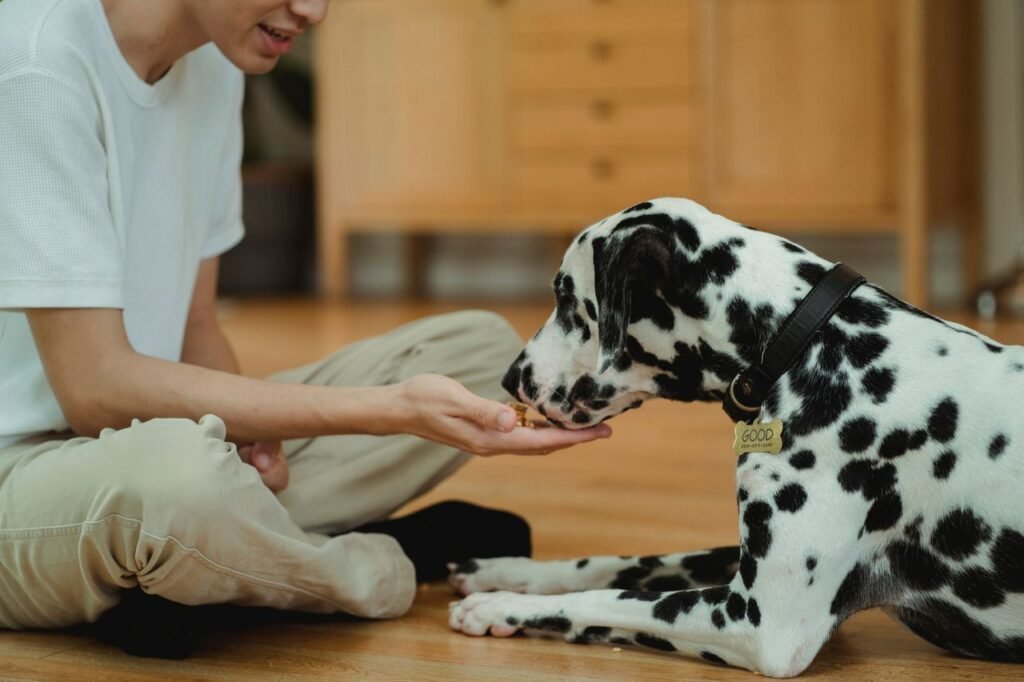
Food is particularly useful because it can be delivered quickly and in small amounts. In one study comparing food with brief human social interaction, food was the more effective reinforcer for most of the dogs studied. Another study comparing edible and leisure reinforcers also found food was preferred by most dogs, while individual preferences still varied.
Other outcomes can reinforce behaviour too, including play, social interaction, access to sniffing, movement, creating distance, going outside or getting to greet someone. What matters is what this dog values in this moment.
One exercise I often give clients is to build a rough list of their dog’s low-, medium- and high-value reinforcers from the dog’s point of view.
Regular kibble might be plenty for practising an easy behaviour in the kitchen. A soft training treat may be more useful outdoors. Cheese might produce considerably more enthusiasm when the task is difficult.
Then a squirrel appears and your carefully researched cheese hierarchy collapses.
That’s normal. Reinforcer value changes with context, hunger, recent access, emotional state, competing opportunities and how much effort the dog is being asked to make. Your list is a starting point for observation, not a permanent ranking.
You can explore this in more detail in What’s the best reinforcer for dog training?.
Help your dog discover the behaviour
Before we can reinforce a new behaviour, we need some way to get it happening.
There are several useful approaches, and no single one is best for everything.
Capturing means noticing something the dog already does naturally and reinforcing it when it happens. If your dog lies quietly on their bed, you can mark and reinforce that behaviour rather than first asking them to do something different.
Shaping means reinforcing small steps toward a finished behaviour. Instead of waiting for the entire behaviour, we make progress worthwhile along the way.
Luring uses something the dog wants, often food, to guide movement. It can be a very practical way to get a new behaviour started. The important part is fading the lure so the dog isn’t waiting to see food before they know what to do.
Targeting teaches a dog to move toward or touch something, such as placing their nose against a hand target. Once learned, targeting can be a handy way to teach movement and positioning without physically manipulating the dog.
The best method depends on the behaviour, the dog and the person teaching it. Sometimes we’ll combine approaches as the behaviour develops.
Teach the behaviour before naming it
Dogs aren’t born knowing that the word “sit” means putting their bum on the floor.
A cue gets its meaning through learning.
It’s usually easier to get a new behaviour happening first, then introduce the cue once the dog is beginning to understand what behaviour earns reinforcement. Over time, the cue starts to predict that this particular behaviour is the one that will pay off.
Repeating a word while the dog is still confused doesn’t make the word clearer. If we say “come” over and over while the dog continues doing something else, we may accidentally teach that the sound isn’t especially relevant.
Clear cues are built through good learning history, not volume or enthusiasm.
Markers make the right moment clearer
A marker helps identify the exact moment a dog has done something we want to reinforce.
At Belle & Bark, I usually teach clients a verbal marker such as “Yes.” If I’m teaching a dog to put one paw on a small target, the marker lets me identify that precise movement before I deliver the food.
Clickers can do the same job, and I like them when very precise timing is useful. Their short, consistent sound can make it easier to mark tiny movements accurately.
For many guardians, though, a verbal marker is simply more comfortable. Managing a leash, treats, timing and an enthusiastic dog can already involve enough hands without adding another piece of equipment.
Research comparing clickers, verbal markers and other reinforcement procedures has not found a universal advantage for one method over the others, so I see clickers and marker words as useful tools rather than competing camps. What matters most in everyday training is that the marker is clear, well timed and reliably followed by reinforcement.
Make success easy and frequent
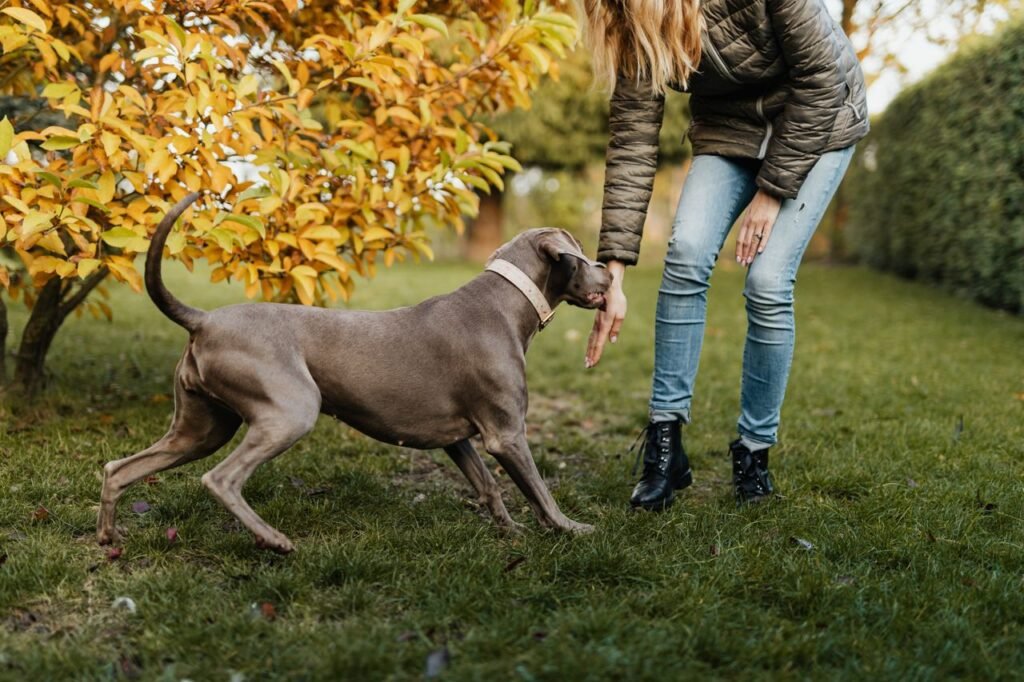
Good training gives the dog lots of opportunities to be right.
Timing matters because consequences are easiest to connect with behaviour when they happen close together. If your dog performs the behaviour and you immediately mark and reinforce it, the information is much clearer than if several other things happen before the treat eventually arrives.
Difficulty matters just as much. If a dog is repeatedly unsuccessful, the answer usually isn’t more repetitions of the same difficult task. We can make the behaviour easier, reduce distractions, improve the reinforcement or break the skill into smaller pieces.
Imagine teaching loose-leash walking in your hallway and then expecting exactly the same performance beside a busy park full of dogs, smells, cyclists and dropped sandwich crusts. The dog hasn’t suddenly forgotten everything. We’ve dramatically changed the assignment.
Training works better when we increase difficulty gradually enough that the dog can keep succeeding along the way.
Bigger behaviours need smaller steps
Many things we casually describe as one behaviour are actually collections of skills.
Loose-leash walking involves staying connected with the person, responding to changes in direction, managing exciting smells and movement, navigating distractions and learning what happens when the leash becomes tight.
A relaxed station on a mat may begin with simply looking toward the mat, then stepping onto it, staying there briefly and eventually settling comfortably.
Shaping lets us reinforce those achievable pieces instead of waiting for the finished behaviour to appear.
If training gets stuck, one of my favourite questions is simply: Can I make the next step smaller?
That usually gives us somewhere useful to go.
“But they know this!”
Dogs don’t automatically understand that a skill learned in one situation applies everywhere.
A dog who sits beautifully in the kitchen has practised sitting in that environment, with familiar surfaces, smells, distractions and reinforcement history. Performing the same behaviour on a busy sidewalk near another dog is a much harder version of the task.
This is called generalization. We help dogs generalize by gradually practising learned skills in different places, around different distractions and under slightly different conditions.
Dogs are also very good at noticing details humans overlook. Your position, the room, the flooring, whether you’re holding a treat pouch, who has the leash and what else is happening nearby can all become part of the learning picture.
So when a familiar cue suddenly seems to vanish outdoors, your dog may not have developed selective amnesia. They may simply need help learning that version of the skill.
Do I have to use treats forever?
Food is especially useful while a dog is learning because it gives us a quick, practical way to reinforce lots of successful repetitions.
As skills become more established, reinforcement can become more varied and fit naturally into everyday life. Coming when called can sometimes be followed by going back to play. Walking on a loose leash allows the walk to continue. Waiting at the door leads to getting outside.
Those outcomes can reinforce behaviour when the dog genuinely values them.
There’s also no need to rush to make food unpredictable. In one study comparing constant and varied food rewards, dogs preferred the option associated with a consistent food reward. That doesn’t tell us that reinforcement should always remain identical, but it’s a useful reminder that variability isn’t automatically more motivating for dogs.
Rather than thinking about “getting off treats,” I prefer to think about maintaining behaviours. Reinforcement can become more varied where that makes sense, everyday life can provide useful outcomes, and food can stay in the picture whenever it remains helpful.
Dogs generally don’t object to being paid for work they already know how to do. Fair enough.
Learning depends on the dog and the moment
Learning principles may be consistent, but individual dogs and situations are not.
Physical discomfort, fear, excitement, fatigue, competing motivation, previous experience and the environment can all affect a dog’s ability to participate. Something that was easy yesterday can genuinely be harder today because the circumstances have changed.
Trainer Susan Garrett has a phrase I come back to often: “our dogs are doing the best they can, with the education we’ve given them in the environment that we’ve put them in.”
I like it because it puts our attention back on the teaching. If a dog is struggling, the task may be too difficult, our cue may be less clear than we think, the environment may be asking too much, our reinforcement may not be strong enough for the situation, or we may simply have chosen a poor time to train.
This kind of individual adjustment is one of the advantages of private dog training, where the plan can be adapted to the dog, the household, and the situations you’re actually working through.
The dog’s behaviour gives us feedback about the plan. Our job is to use it.
Sometimes that means making the exercise easier or changing the environment. Sometimes we need to rethink our timing or reinforcement. And sometimes the best choice is to stop and try another day.
The dog isn’t the only learner in the room.
This broader view of learning is part of the approach I describe in Training with heart and science: What we believe.
Learning is bigger than training
Knowing how learning works can make us better teachers, but dogs spend most of their lives doing things other than formal training.
They learn while exploring, interacting with us, navigating their environment and discovering what their own behaviour makes possible. Some of those lessons are ones we intentionally create, and plenty happen without us.
The goal isn’t to turn everyday life into one continuous training exercise. It’s to understand enough about learning to communicate clearly when we do need to teach something, recognize what our dogs are learning from the world around them, and change our approach when the lesson isn’t landing.
That leaves plenty of room for sniffing, resting, playing, exploring and simply being a dog.
If you’re interested in how choice and control fit into that bigger picture, you can read Dog training and agency: Why choice matters.
Frequently asked questions
What is positive reinforcement in dog training?
Positive reinforcement happens when something is added after a behaviour and that behaviour becomes more likely in the future. Food is commonly used because it is practical and effective for many dogs, but anything the dog values can potentially function as reinforcement.
What is negative reinforcement?
Negative reinforcement means something is removed or reduced after a behaviour and that behaviour becomes more likely. “Negative” refers to something being taken away, not to the consequence being bad.
In everyday life, the thing removed is often something the dog wanted to escape or avoid, which is why many examples involve relief from pressure or unwanted proximity.
What’s the best way to teach a new behaviour?
It depends on the behaviour and the dog. Capturing, shaping, luring and targeting are all useful ways to help a dog discover what earns reinforcement. Good teaching keeps the steps achievable, reinforces success and introduces a cue once the behaviour is becoming clear.
Why does my dog listen at home but not outside?
Dogs don’t automatically generalize a learned skill to every environment. Something easy in the kitchen can become much harder around traffic, dogs, people, smells or other distractions. Practise in gradually more challenging situations rather than assuming the dog already understands the skill everywhere.
How do I know what my dog finds rewarding?
Watch what actually affects their behaviour. Building a rough low-, medium- and high-value reinforcer list can help, but remember that value changes with context. What works in your living room may be very different from what matters beside a squirrel-filled park.
Do I need to stop using treats once my dog learns something?
No. Reinforcement can become more varied once a skill is well established, and everyday activities can sometimes reinforce behaviour naturally. There’s no requirement to eliminate food simply because the dog understands the behaviour.
Want to go deeper?
If you enjoy the learning science and want something much more comprehensive, Mary R. Burch and Jon S. Bailey’s How Dogs Learn is an excellent next step.
It goes considerably deeper into reinforcement, punishment, shaping, extinction, stimulus control and behaviour-change procedures while keeping the material grounded in dog training. It’s a useful resource if you want to understand the science underneath the practical techniques in this article.

Tabitha Turton
Tabitha Turton is the founder and trainer at Belle & Bark, offering dog training and behaviour support in Montreal. Her work draws on current behaviour and welfare science, positive reinforcement and Family Dog Mediation, with a focus on understanding the individual dog and the factors shaping their behaviour.
Her writing explores dog behaviour, learning and welfare, translating research and professional education into practical ideas for everyday life with dogs.