Senior dog weight loss: One block at a time with Maya
“Hustle, hustle.”
That became our little downstairs routine during Maya’s first few weeks with us. The hardest part was the stretch from the elevator to outside the building. Maya would slowly make her way through the basement hallway, pause for frequent breaks, and stare at us for moral support. She was moving at a pace that suggested she was summiting Everest instead of heading outside in Westmount for a bathroom break. By the time we reached the sidewalk, she sometimes already looked tired.
We adopted Maya from the Montreal SPCA on April 11, 2025. She was ten years old and morbidly obese, carrying 51.6 kilograms on a frame built for far less. The SPCA had even featured her story in their newsletter and on Instagram as a cautionary tale of when “treats do more harm than good”.
When we brought her home, she wasn’t just carrying an immense amount of extra weight; she was also navigating chronic infections and severe physical discomfort. Movement was so difficult that everything else became secondary to food. She was food-frantic, her mind entirely consumed by where her next meal was coming from. On that first night, staring at this giant, uncomfortable senior dog who could barely manage a few steps without overheating, the reality of the situation hit me. I sat there wondering if I was truly prepared for the scale of what we had taken on.
As the months went on, people occasionally stopped us to ask if she was “the dog from Instagram.” A dog carrying that much extra weight has a very distinctive silhouette that tends to stick in people’s minds, and the community remembered her. But long before the neighbourhood knew her, the moment we first met Maya at the shelter, we just wanted to help her. She was immediately friendly and deeply sweet; there was never any question about whether she enjoyed people. What slowly emerged over time was just how funny, energetic, opinionated, and surprisingly precocious she could be once her body started feeling better. At first, Maya mostly cared about food and lying down. These days she has hobbies.
The early weeks
The first few weeks revolved around logistics: ramps, slow walks, monitoring stairs, checking weather forecasts, and constantly trying to figure out how much movement was helpful versus exhausting. Maya changed the rhythm of our household almost immediately because everything became slower. Simple outings required planning. We started automatically noticing curbs, slippery sidewalks, long staircases, and how humid the air felt before leaving the apartment.
Maya taught us to slow down, too. We spent more time sitting on benches, standing in patches of grass, and simply watching the neighbourhood than we ever had before. Once you stop worrying about distance and start paying attention to the dog in front of you, the pace of a walk changes considerably. Some winter walks involved navigating icy sidewalks at approximately the same speed as continental drift, while Maya carefully evaluated every patch of questionable slush before committing to it.
There were also moments that felt discouraging. Some days Maya looked sore before the day had even really started. There were walks that ended after half a block because she clearly wanted to go home. Early on, she strongly preferred staying close to the building, so crossing the street felt like a major commitment.
The first time Maya voluntarily chose to cross the street instead of turning back toward home, I cried. Not because crossing a street is inherently impressive, but because it represented something much bigger. Up until then, Maya had spent months choosing the familiar route home. Watching her decide to keep going felt like watching her trust her body a little more and discover that the world might extend beyond the nearest corner.
We listened to her constantly. If she slowed significantly, looked physically tired, or disengaged from the environment, we shortened the walk and headed home. We never wanted movement to become something she pushed through simply because a human had decided it was exercise time. Some days the goal was simply getting outside for a few minutes, doing a bit of sniffing, moving around a little, and then heading home again. Those tiny outings mattered.
Practical strategies for senior dog weight loss
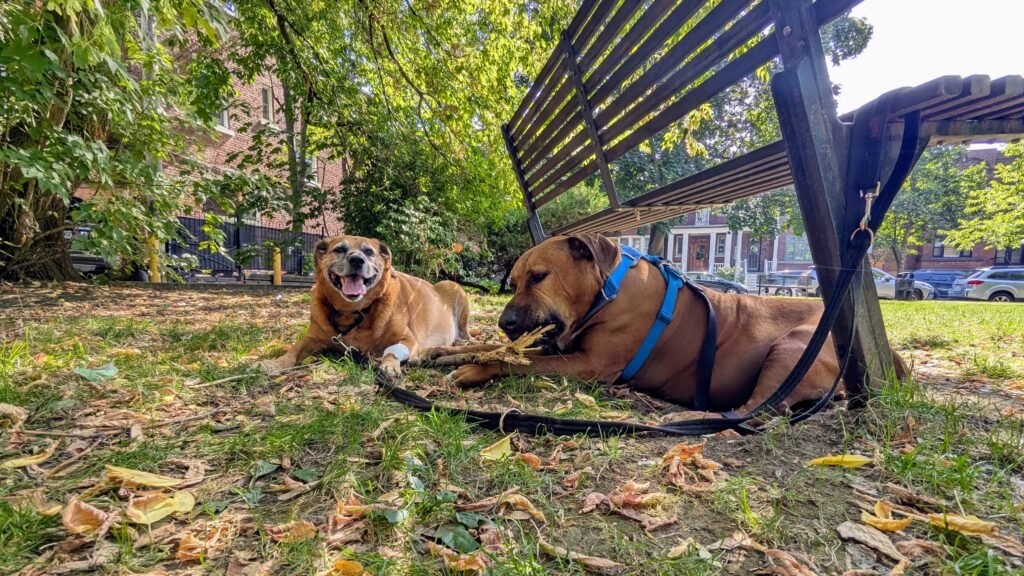
People sometimes ask what finally worked for Maya, and the truth is that it was a lot of small things repeated consistently over time. When navigating senior dog weight loss, short, frequent walks often help far more than occasional ambitious ones. We started with at least six short walks a day, and now we are down to about four. Maya slowly built stamina without overwhelming herself physically, and we adjusted constantly based on weather, soreness, and energy levels. Summer humidity hit her especially hard, while winter demanded balance and coordination from a body already working overtime. On difficult weather days, we adjusted our plans instead of forcing the issue.
A lot of Maya’s recovery involved simply letting her be a dog. Some days that meant slow, sniff-heavy walks. Other days it meant sitting outside together people-watching while Maya monitored the neighbourhood like a retired security guard with extremely flexible hours. We looked for activities Maya genuinely enjoyed, things that encouraged movement, curiosity, comfort, and connection without overwhelming her physically. The goal was always quality of life, not running drills or turning her recovery into an obedience project.
Hide and seek quickly became one of Maya’s favourite games. I’d hide somewhere in the apartment, usually behind a door or shower curtain, call out to her, and she’d slowly wander around trying to track me down. During the warmer months, we also started playing little recall games outside during our final evening walk. I’d have Maya wait a short distance away, then call her to me and encourage her to waddle between my legs for a big reward. Making movement fun turned out to matter a lot. If she was excited about the activity itself, she moved more willingly and confidently. We paid her well for the big energy expenditures.
On difficult weather days or when her joints were stiff, predictability became our best tool. We relied heavily on counting games, such as Leslie McDevitt’s 1-2-3 pattern, which create a simple, reliable rhythm. Because Maya knew exactly when and where the next piece of food was coming from based on the count, her nervous system could relax. That predictability reduced the stress of navigating a tricky environment, turning a stressful walk into a safe, familiar routine.
We also used a simple touch cue, teaching her to target her nose to my hand. On walks, this became a gentle way to guide her weight down off a curb or help her adjust her alignment on a slippery sidewalk. Instead of using leash pressure or repeated verbal prompting, which can add frustration to physical discomfort, the touch cue let her move her own body willingly and with coordination.
Managing Maya’s recovery wasn’t happening in a vacuum. We also share our home with Oliver, our other dog, who navigates his own complex autoimmune disease and health challenges. Initially, we kept their walks completely separate. Oliver needed to enjoy his life and move at a normal pace, and Maya simply couldn’t keep up. Managing one dog who wanted to forge ahead and another who wanted to stay rooted to the spot was a recipe for mutual frustration.
But as Maya built a base level of stamina, we started experimenting with short, joint walks. Having Oliver there completely changed her mindset and she tried her best to keep up. Of course, that meant some of Oliver’s walks became intentionally shorter, so we adapted by finding beautiful patches of grass where we could all settle down, rest, and people-watch together.
Through all of this, our veterinary team was our lifeline. On that overwhelming first morning after adoption, their understanding and encouraging words talked me down from my anxiety. They helped us design a precise nutrition plan, transitioning her to a therapeutic veterinary diet focused on satiety and joint support.
Because I focus heavily on the overall welfare of an animal, I refused to let Maya feel like she was starving while losing weight. We meticulously tracked her intake, ensuring she got her main food throughout the day via puzzles, snuffle mats, and outdoor food scatters, while reserving about 10% of her daily calories for high-value treats. This kept her brain active, got her working her core muscles while standing, and ensured she felt both satisfied and motivated.
Our close relationship with the vet also helped us stay on top of her ongoing health. Because she was prone to urinary tract infections, we had her urine checked every month or two. Keeping close tabs on her habits helped us spot unusual patterns early, which led to a diagnosis of Cushing’s disease. Getting her on the proper medication quickly improved her skin, coat, and hydration habits.
Every time we went back for a weigh-in, the entire clinic invested in her journey. When she first arrived, she looked unlike any dog I had ever seen, her body under immense strain. When she finally “made weight” to undergo a critical dental surgery she desperately needed this past February, the whole office exploded in cheers. It really is meaningful to have support from your community when you are navigating a long recovery.
Meeting the real Maya
As a Family Dog Mediator, I’m always looking at a dog through the LEGS framework, assessing how their Learning, Environment, Genetics, and Self all interact to shape their behaviour. The “Self” leg, which includes a dog’s unique physical body, age, and health, is a massive factor in senior dog weight loss. When Maya first arrived, her severe physical limitations masked so much of who she was, and the Learning and Environment parts of the equation were entirely focused on safety and resting.
But as her discomfort dropped and her nutrition plan took effect, her internal landscape completely shifted. Her physical “Self” changed, and as it did, her true personality started showing up everywhere. We finally got a clear look at her genetic heritage.
Based on her traits, Maya likely stems from the gun dog and herding dog breed groups. As her body healed, those ancestral blueprints woke right up. The first time she initiated tug play, we both just stared at her for a second in complete disbelief. Up until then, Maya had mostly been interested in food and conserving energy. Watching her suddenly grab a toy and want to engage with us felt like meeting an entirely different side of her personality, a classic herding trait of wanting to cooperate and interact through physical play.
Her inner gun dog came online, too. Her sense of smell is spectacular, and our slow walks took on a whole new layer of complexity when she single-handedly took over Westmount rabbit surveillance duties. Just the other night, she spotted a bunny and took me on a determined, trotting path to follow its trail. Because her passion for scavenging will likely never leave her, we implemented a strong “leave it” cue alongside outdoor food scatters, redirecting her natural drive into safe, rewarding enrichment.
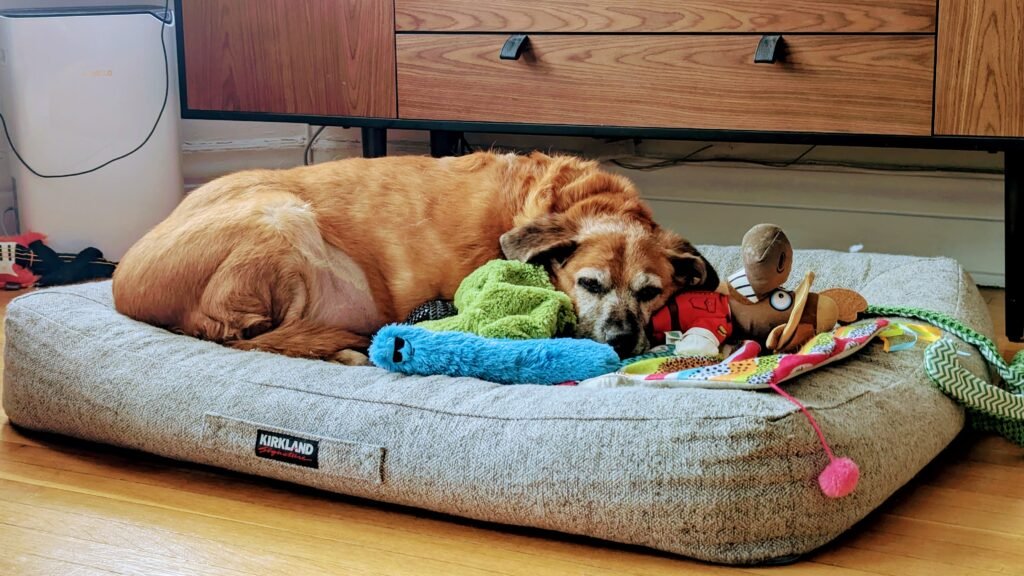
At some point, she also started carrying toys around the apartment. She just seemed genuinely pleased to have them, slowly parading through the living room carrying a stuffed dog, relocating it twenty minutes later, and repeating the process like she had a very specific organizational system we were not privy to.
She became more adventurous over time, although she still strongly believes most activities should include multiple breaks and ideally snacks. There were quieter changes too: the first time she confidently invited herself onto the couch instead of hesitating beside it, watching her recover more comfortably after walks, seeing her trot instead of shuffle, and watching stairs become less intimidating. Maya also developed very strong feelings about butt scratches, and she has learned from Oliver to reverse directly into people for them as though this is a completely normal social interaction.
The world got bigger
One of the most beautiful parts of Maya’s journey has been how invested complete strangers became in her progress. Some recognized her from the SPCA post, while others simply became familiar with the waddling senior dog making her way around Westmount every afternoon.
One neighbour became Maya’s unofficial hype woman, always asking for updates on how far she was walking. There was also a construction worker we passed almost every morning during those early weeks. As Maya slowly worked her way down the sidewalk, he called out, “You’re doing great! I see you out here every morning and it’s really making a difference.” I appreciated that more than he probably realized.
But navigating the neighbourhood wasn’t always easy. Maya changed the way I look at other dogs and guardians in public because of how heavy the early days felt. Walking a dog through a major weight loss journey means carrying the weight of public perception, too. I often caught the looks of judgment from strangers, the unspoken assumption that I was the one responsible for her condition, that I had done this damage to her. People see a dog struggling physically and write a story in their heads, completely unaware that they are actually looking at the very beginning of a long, careful rescue recovery.
A slow-moving dog may be healing from pain, trauma, or years of neglect. The person stopping every few minutes may already be doing everything in their power to help. You really don’t know what someone else is navigating, or how much love and effort is happening at the other end of that leash.
On April 29, 2026, Maya stepped onto the scale at her latest vet check. She weighed 36.4 kilograms.
She has officially lost over 15 kilograms since the day she came home. We still have a long-term goal of shedding another 8 to 10 kilograms to bring her into a comfortable maintenance range, but we are in no rush. Recovery at this scale is a marathon, not a sprint. We are making decisions for the next several years of her life, not the next several months.
Last October, after months of tiny loops and turnaround points, Maya completed her first full one-kilometre walk to Westmount Park. Getting there felt monumental. We took photos, celebrated, and absolutely texted people about it afterward.
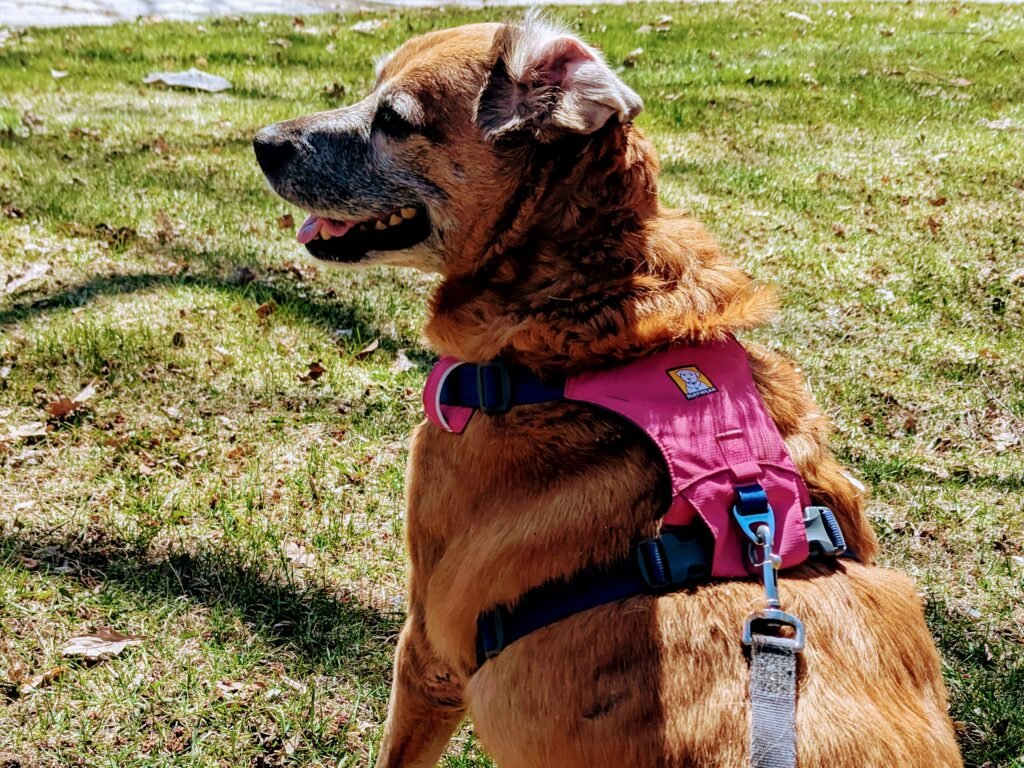
These days, she does that walk a few times a week. She walks ahead of me now, leading the way with Oliver, her tongue hanging happily out the side of her mouth in what looks like a permanent smile. She knows exactly which neighborhood shops hand out treats, and she insists on visiting them. Maya’s world got bigger because we chose to slow down, look at her entire ecosystem, and listen to what her body was telling us.
You do not have to navigate this alone
If you are currently sitting on your living room floor with a newly adopted dog, a struggling senior, or a pet facing a massive chronic health or mobility challenge, and feeling entirely overwhelmed, I want you to take a deep breath.
Progress is rarely linear, and the early days can feel incredibly isolating. But meaningful change happens when we stop looking at training as a series of rigid obedience drills and instead look at the whole dog. By focusing on physical comfort, finding the right dietary support, mapping out predictable routines, and leaning into activities they naturally find fulfilling, we can completely transform their quality of life.
Senior dog weight loss usually moves slowly, but you do not have to map out this logistics puzzle by yourself, and you do not have to carry the weight of public judgment alone.
If you are in the Montreal area and looking for a calm, science-informed partner to help you find practical strategies that support your dog’s comfort, confidence, and quality of life, please reach out. We would be happy to help you take that very first block together.

Tabitha Turton
Tabitha Turton is the founder and trainer at Belle & Bark, offering dog training and behaviour support in Montreal. Her work draws on current behaviour and welfare science, positive reinforcement and Family Dog Mediation, with a focus on understanding the individual dog and the factors shaping their behaviour.
Her writing explores dog behaviour, learning and welfare, translating research and professional education into practical ideas for everyday life with dogs.