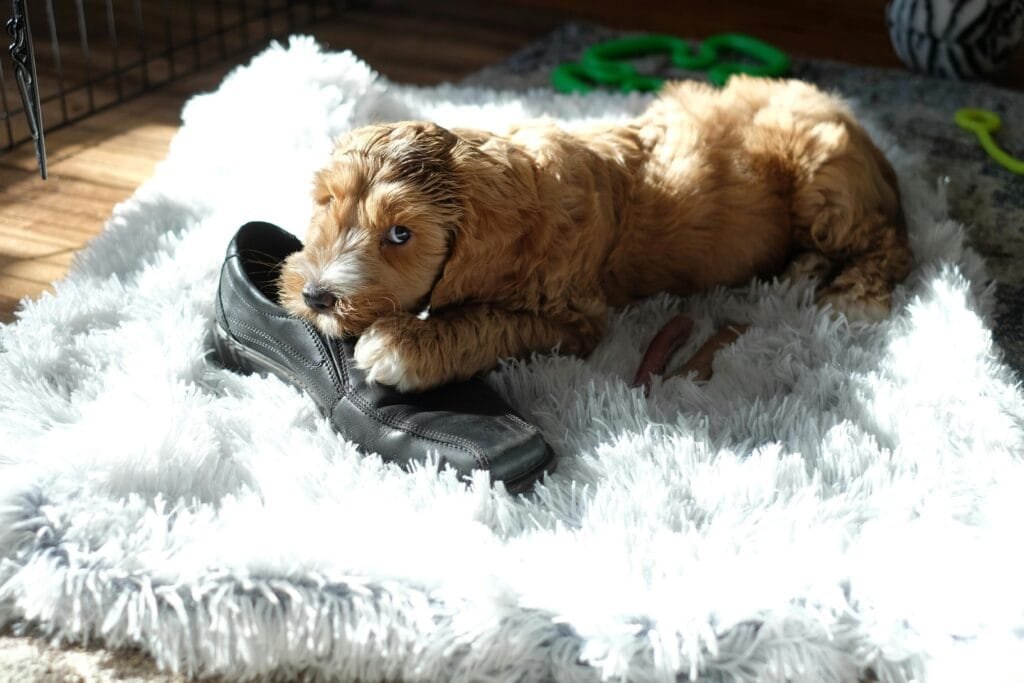
Resource guarding in dogs: What to do and how to help
You reach towards your dog’s chew and they suddenly go still. Maybe they lower their head over it, move away with it, eat faster, or give a low growl. These are all ways a dog may try to keep control of something they value.
Resource guarding can involve food, toys, chews, resting places and other valued resources. Some dogs show very subtle signs, while others may growl, snap or bite. Understanding those early signals gives us more options for keeping everyone safe and helping the dog feel more comfortable around their resources.
Quick takeaways
- Resource guarding describes behaviours dogs use to maintain access to something they value.
- Early signs can include freezing, eating faster, hovering over an item, moving away with it or watching someone closely as they approach.
- Avoid taking valued items away to test your dog or prove that you can.
- Management is an important part of keeping both dogs and people safe.
- Teaching trades and a reliable drop cue can make everyday situations easier.
- Guarding involving children, bites, multiple dogs or escalating aggression is a good reason to seek professional help.
What is resource guarding in dogs?
Resource guarding is a group of behaviours a dog may use to keep control of something they value when a person or another animal is nearby. Researchers have described those behaviours as including avoidance, threats and aggression, as well as things like moving away with an item or eating it quickly.
Food and chews are common resources, but dogs may also guard toys, stolen objects, resting places or access to particular spaces. Some dogs appear to guard proximity to a person as well, although behaviour involving people or locations can be more complicated and deserves careful assessment.
Resource guarding is sometimes called possessive aggression or food aggression, but resource guarding is the clearest and most useful term because aggression is only one possible part of the picture.
Early signs of resource guarding
Guarding often starts well before a growl or snap. You might notice your dog:
- freezing or becoming suddenly still
- lowering their head or body over an item
- eating faster when someone approaches
- carrying the resource away
- turning their head or body to block access
- watching someone closely from the corner of their eye
- stiffening as a person or another dog comes closer
More obvious responses can include growling, snarling, snapping, lunging or biting.
Paying attention to the quieter signals matters. They give us information about when the dog is becoming uncomfortable and allow us to change the situation earlier.
Why do dogs resource guard?
There probably isn’t one simple explanation.
Research has found associations between resource guarding and characteristics such as fearfulness and impulsivity, but that does not tell us that either one directly causes the behaviour. Learning history can also matter. If moving away with an object, freezing or growling reliably makes someone back off, those behaviours may continue to work for the dog.
Experiences around resources can shape expectations too. In one large survey, dogs whose food bowls were removed during meals were more likely to show more severe or frequent guarding, while adding something tasty to the bowl was associated with less severe guarding. These are associations rather than proof of cause, but they support a practical point: repeatedly taking things away is unlikely to help a dog feel safer about people approaching their resources.
Individual dogs also vary enormously. Genetics, temperament, previous experiences, household dynamics, the value of the resource and the presence of other dogs can all be relevant.
Understanding the context is usually more useful than trying to reduce guarding to dominance, stubbornness or a dog being “possessive.”
What to do when your dog is guarding
Safety comes first. When a dog is already tense over a resource, that is not the time to practise taking it away or to see how much handling they will tolerate.
What to do in the moment
If your dog is guarding something, give them space and avoid reaching towards the resource. Keep children and other animals away, and let the situation settle before deciding what to do next.
If you need to retrieve something dangerous, such as medication, cooked bones or another unsafe object, you can try tossing high-value food away from the item so your dog moves away voluntarily. Once they are safely occupied elsewhere, pick up the object without rushing back towards them.
Avoid grabbing the item, reaching into your dog’s mouth, scolding them or trying to prove that you can take it. Those responses can make an already tense situation more difficult.
Growling is useful information. It tells you your dog is uncomfortable and wants more distance. Give them that space and make a note of what happened so you can adjust the environment or training plan afterwards.
If dangerous-object guarding happens repeatedly, or your dog is snapping, lunging or biting, get professional help rather than relying on trades in increasingly risky situations.
Management at home
Good management reduces the number of situations where the dog feels they need to guard.
Depending on the household, that might mean feeding dogs separately, giving high-value chews behind a gate, picking up valued toys before visitors arrive, or making sure children do not approach a dog who is eating or resting with something valuable.
Children need particular care around resource guarding. Studies of dog bites involving children have found resource guarding to be a common context for bites to young children. Adults should manage access rather than relying on a child to remember when it is safe to approach.
Management does not mean you have failed to train the dog. It creates safer conditions while you work on the behaviour.
Teaching trades and safer exchanges
A trade teaches the dog that giving something up can lead to another worthwhile outcome.
Start with objects your dog is comfortable releasing. Offer something they value more, such as a good treat, and allow them to move away from the original item voluntarily. Once they understand the pattern, you can add a cue such as “drop.”
Sometimes you can return the original item after the trade. That helps prevent every exchange from predicting permanent loss.
Survey research has found an association between reliably dropping items on request and lower odds of aggressive resource guarding. That does not prove that teaching “drop” prevents guarding, but it supports the skill as a useful part of everyday management and training.
You can also change what your approach predicts. If your dog is comfortable enough for you to pass at a distance, you might occasionally toss something tasty and continue on your way. The goal is for your presence near a resource to become predictable and safe.
For a dog who already guards intensely, exercises involving approaches to valued resources should be planned carefully. Moving too quickly can make the problem harder.
Can resource guarding improve?
Yes, many dogs can make meaningful progress. What that looks like depends on the dog, the resources involved, the severity of the guarding and the household.
For one dog, success might mean comfortably trading toys and relaxing when a guardian walks past the food bowl. For another, long-term management around high-value chews may still be sensible even after substantial improvement.
The goal is a safer, more comfortable dog and household, rather than proving that anyone should be able to take anything from the dog at any time.
What about puppies?
Puppies can show resource guarding too. Early habits around food and toys are worth paying attention to, especially if a puppy freezes, runs away with objects, eats frantically when approached or growls.
You can help build good expectations by approaching to add something valuable, practising easy trades and avoiding games where people repeatedly grab objects from the puppy.
Puppies also benefit from learning that human hands near their resources often predict good things.
Will neutering or spaying help with resource guarding?
Neutering or spaying is not considered a treatment for resource guarding. Research on reproductive status and resource guarding is inconsistent, and there’s no good evidence that neutering reliably reduces the behaviour.
One large survey found that neutered males were more likely to show resource-guarding aggression around other dogs, but because the study was observational, it cannot tell us whether neutering contributed to the behaviour or whether other factors explain the association.
If resource guarding is the concern, management and behaviour work are the more useful places to focus. Decisions about spaying or neutering are best made with your veterinarian based on the individual dog’s health, age, breed and circumstances.
When to get professional help
Professional support is especially important when resource guarding involves biting, snapping, children, conflict between dogs, guarding of multiple resources, or behaviour that is becoming more frequent or intense.
A behaviour professional can help identify the situations that trigger guarding, assess risk, build a management plan and decide which training exercises are appropriate for that particular dog.
It is also worth speaking with your veterinarian if the behaviour appears suddenly or becomes worse. Pain and other health changes can affect how comfortable a dog feels when people or animals approach them, particularly around resting places, handling or movement.
At Belle & Bark, Behaviour solutions looks at the whole picture around guarding, including the dog’s environment, learning history, stress, household routines and the resources involved. The aim is to make daily life safer while helping the dog develop more comfortable ways of navigating those situations.
Resource guarding can be unsettling, especially when growling or biting is involved. Taking those signals seriously, reducing unnecessary conflict and working at a pace the dog can handle gives us a much better foundation for improvement.

Tabitha Turton
Tabitha Turton is the founder and trainer at Belle & Bark, offering dog training and behaviour support in Montreal. Her work draws on current behaviour and welfare science, positive reinforcement and Family Dog Mediation, with a focus on understanding the individual dog and the factors shaping their behaviour.
Her writing explores dog behaviour, learning and welfare, translating research and professional education into practical ideas for everyday life with dogs.