The Five Domains of animal welfare: What they mean for your dog
Percy had a lot going for him.
He lived with a big family who adored him. He ate well, was healthy, had daily walks and access to a backyard, and I saw him four times a week for enrichment walks.
Then adolescence arrived, and things got hard.
Percy was becoming intensely frustrated and hyperaroused. He could go from doing fine to completely overwhelmed very quickly, and once he got there, thinking and settling were difficult. Because he’s a giant-breed dog, that level of arousal was also becoming a safety concern.
It would have been easy to look at his routine and conclude that he already had plenty. He exercised. He got enrichment. He had outdoor space. His family was attentive and involved.
But clearly, something wasn’t working well enough for Percy.
That’s one reason I find the Five Domains of animal welfare so useful. It gives us a way to look beyond what we provide and ask a much more interesting question: what is the dog actually experiencing?
Quick takeaways
- The Five Domains look at nutrition, environment, health, behaviour, and mental state.
- The fifth domain asks the big question: how does life feel to the dog?
- Good welfare includes positive experiences, not just the absence of problems.
- A dog can be well cared for and still have unmet needs.
- Looking across all five domains can reveal where support may be missing.
- Chronic fear and anxiety have been linked with poorer health and shorter lifespan in dogs.
What are the Five Domains of animal welfare?
The Five Domains Model comes from animal welfare science and has been developed and refined since the 1990s. It looks at five interconnected areas of an animal’s life:
- Nutrition
- Physical environment
- Health
- Behavioural interactions
- Mental state
The first four domains give us information about what is happening to and around the animal. We then use that information to think carefully about Domain 5: the animal’s likely mental and emotional experience.
That fifth domain is where things get especially interesting.
Nutrition
This includes appropriate food and reliable access to water, along with the physical experiences that come with eating and drinking.
For a family dog, there may also be opportunities here for sniffing, foraging, licking, chewing or solving a simple food puzzle. One dog may happily spend ten minutes searching the grass for scattered kibble. Another may stare at you as though you’ve dropped their dinner by accident and are inexplicably refusing to pick it up.
The dog gets a vote in whether something is enriching.
Physical environment
This includes temperature, surfaces, space, shelter, noise and access to comfortable places to rest.
A home can look perfectly comfortable to us while still containing things that make life harder for a particular dog. Slippery floors can be difficult for an older dog. A window facing a busy sidewalk can keep another dog on neighbourhood watch for half the afternoon. A bed in the centre of family activity may not be especially restful when everyone gets home at 4 p.m.
Sometimes adding a rug, closing a blind or giving a dog somewhere quieter to sleep changes more than another round of training would.
Health
Pain, illness, mobility, digestive problems, itching, dental discomfort and other physical issues can all affect behaviour.
Sometimes the connection is obvious. Sometimes it looks like a dog who suddenly doesn’t want to climb the stairs, becomes less tolerant of handling, sleeps more, or starts getting irritable in situations they previously managed easily.
Maya has been a very good teacher here.
When we adopted her as a senior dog, she was severely overweight and moving around took real effort. As her health improved and the weight came off, she started walking farther, exploring, playing and generally involving herself in more of the world around her.
We didn’t install a new personality. We were finally getting to see more of the one that had been there all along.
I wrote more about Maya’s weight-loss journey and how her life changed as her health improved.
Behavioural interactions
This domain looks at how animals interact with their physical environment, other animals and people. It also includes opportunities for agency: being able to make choices and have some influence over what happens.
For a dog, that might include sniffing, exploring, playing, chewing, digging, learning, resting undisturbed, spending time with other dogs, seeking affection, walking away from something uncomfortable or choosing which way to go on a walk.
It also makes a sentence like “he gets two walks a day” much less informative than it first appears.
One thirty-minute walk could involve sniffing, wandering, checking out interesting things and moving through an environment the dog is comfortable in. Another could involve thirty minutes of frustration, leash tension and repeatedly encountering things the dog finds overwhelming.
Both still go in the diary as a walk.
Why Domain 5 matters so much
Domain 5 is Mental State.
This is where we take what we know from the other four domains and ask what those conditions might mean for the dog’s subjective experience.
Is the dog comfortable? Curious? Interested? Relaxed? Engaged? Frustrated? Afraid? In pain? Bored? Unable to settle?
We can’t ask them directly, so we use body language and behaviour, health, context, preferences and changes over time to make careful inferences.
And this isn’t about expecting dogs to feel cheerful every minute of the day. A good life still includes frustration, disappointment, uncertainty and the occasional squirrel that gets away.
What matters more is the pattern across time.
A dog can spend ten minutes frustrated because the treat ball rolled under the sofa and still be doing very well overall. I’d be much more interested in a dog who seems frustrated through large parts of every day, struggles to settle, repeatedly encounters things that frighten them, or rarely gets access to things they seem to genuinely enjoy.
Positive welfare is more than avoiding bad things
A lot of traditional thinking about animal welfare focused on preventing suffering: enough food, adequate shelter, no untreated pain, no severe fear or distress.
Those things are obviously essential.
Modern welfare science also asks whether animals have opportunities for positive experiences.
I want dogs to have things in their lives that they actively enjoy and seek out. Things that make them curious. Things they choose when they have options.
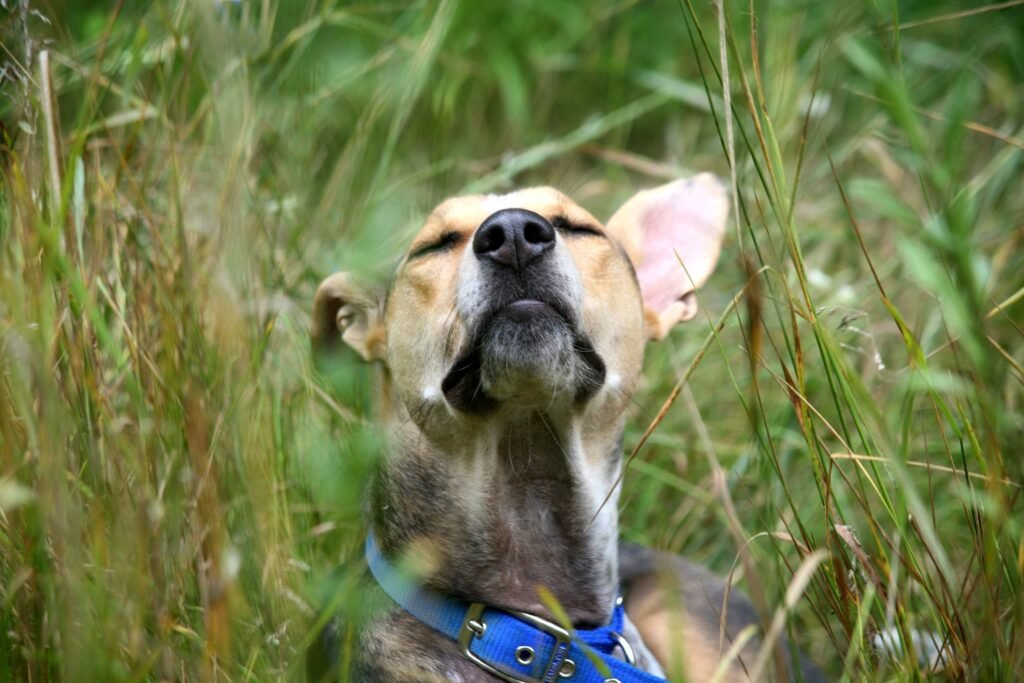
For one dog, that might be wrestling with a familiar friend. For another, it’s following a scent trail through wet grass. Some dogs love learning new things for cheese. Some would much rather dismantle a cardboard box with the concentration of a tiny demolition contractor.
Positive valence simply means the experience feels good to the animal.
That matters because a life made up only of avoiding hunger, pain and fear would be a pretty low bar.
Emotional life can affect physical health too
Helping dogs feel better isn’t frivolous.
Chronic fear and anxiety have been associated with poorer health and shorter lifespan in dogs, while positive experiences are an important part of good welfare.
That doesn’t mean every stressful moment is damaging or that a dog must live in a permanent state of bliss. Stress is part of life, and dogs need opportunities to encounter manageable challenges too.
I’m much more interested in whether they can cope, recover and return to doing things they enjoy.
What this looked like for Percy and Maya
Percy is a good example of why checking the obvious boxes doesn’t always tell us enough.
His nutrition was good. His physical health was being monitored. His home was safe. He had exercise, outdoor access and regular enrichment walks.
Yet frustration and hyperarousal were taking up far too much room in his life.
Percy needed more than activity
We eventually learned that social interaction with other dogs mattered to him. Regular dog-park visits became part of his routine because he genuinely enjoyed them.
That won’t be true for every dog. Some would cheerfully sign a petition to close the dog park permanently.
Percy wasn’t one of them.
His veterinarian also prescribed an SSRI. It helped take some of the edge off the intensity he was experiencing and gave him more capacity to engage with training and everyday life.
We kept the enrichment walks going too.
Over time, things shifted dramatically. He’s still Percy, complete with adolescent enthusiasm, but the intense frustration and hyperarousal that once took over so easily no longer dominate his days.
There wasn’t one magic intervention. Social opportunities mattered. Medication mattered. Enrichment mattered. Training mattered.
We needed the combination that worked for him.
Maya’s route was different
Maya’s story started much more obviously in the Health domain.
When moving was difficult, a lot of other experiences simply weren’t as available to her. She couldn’t comfortably walk as far, explore as much or make the same choices she can now.
As her body became more comfortable, her behavioural world got bigger.
These days, she walks farther, investigates more, plays and has very clear opinions about where she’d like to go.
The health change opened doors elsewhere.
How to use the Five Domains with your own dog
You don’t need to perform a formal welfare assessment every Sunday night.
Try taking the five domains for a wander through an ordinary day instead.
What does eating look like?
Are food and water easy and comfortable to access? Has appetite changed? Are there feeding activities your dog seems to genuinely enjoy?
Where can your dog actually relax?
Look at where they choose to sleep, what happens when the household gets busy, whether noise or window activity keeps interrupting them, and whether they can move somewhere quieter when they want to.
How is their body doing?
Changes in movement, sleep, appetite, toileting, tolerance of touch or everyday behaviour can all be worth noticing. If something changes suddenly or doesn’t make sense, health belongs high on the list of things to investigate.
What does your dog get to do?
Think beyond exercise minutes.
Where are the opportunities to sniff, explore, chew, play, learn, socialize, rest, investigate and make choices? Which of those does your dog actually seek out?
And how does all of that seem to feel?
This is the fifth-domain question.
Where do you see your dog relaxed and absorbed? What seems to light them up? What reliably produces frustration or worry? Do they recover easily after something difficult? Are there parts of the day they seem to dread, and others they come running for?
You may notice an obvious gap. You may discover that the thing your dog needs isn’t more activity at all.
More exercise wouldn’t have solved Percy’s problem by itself. Maya didn’t need a busier enrichment schedule when simply moving around was hard.
Sometimes the answer is medical care. Sometimes it’s better sleep, quieter days, social time, more choice, an easier environment, different enrichment or fewer situations that repeatedly push the dog too far.
Sometimes it takes a bit of detective work, a few experiments, and paying attention to what actually makes your dog’s day easier or better.